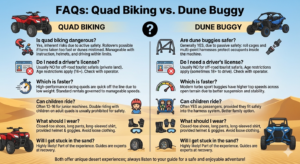
1. Introduction: The Great Desert Dilemma
You are standing at the edge of an endless sea of golden sand. The heat haze shimmers on the horizon, and the promise of adrenaline is palpable in the air. You’ve decided to conquer the dunes, but now you face the classic desert dilemma: Quad biking vs. Dune Buggy?
This isn’t just a choice between two different vehicles; it’s a choice between two entirely different philosophies of adventure. It’s a decision that will dictate how you interact with the terrain, how much physical effort you exert, who you can share the moment with, and ultimately, the kind of memories you will take home.
At first glance, they both seem like noisy machines with knobby tires designed to throw sand. Yet, the experience of riding them could not be more distinct. One offers a raw, exposed, and intensely physical connection to the ground beneath you. The other provides a caged, powerful, and slightly more removed cockpit experience that feels like driving a rally car on Mars.
Choosing the wrong machine can lead to frustration. An anxious beginner might find a powerful quad bike terrifying, while an experienced thrill-seeker might find a basic dune buggy under-stimulating.
To help you navigate this decision, we have compiled the ultimate, definitive guide. We are moving beyond surface-level comparisons to explore the mechanics, safety profiles, psychological thrills, and practicalities of Quad biking vs. Dune Buggy. Whether you are planning a Dubai desert safari, a trip to the glamorous dunes of Glamis, California, or an outback Australian adventure, this comprehensive breakdown will ensure you choose the ride that matches your adrenaline threshold.
2. At A Glance: Rapid Comparison Table
Before we dive deep into the mechanics of the Quad biking vs. Dune Buggy debate, let’s look at the fundamental differences side-by-side.
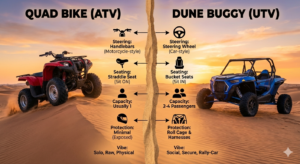
3. Deep Dive: Understanding the Quad Bike (ATV)
To truly grasp the Quad biking vs. Dune Buggy comparison, we must first understand what makes an ATV (All-Terrain Vehicle) tick.
A quad bike is essentially a motorcycle with four wheels. It is designed for a single rider to straddle the machine, actively engaging their body to maneuver it.
The Mechanics of the Beast
Quad bikes used in desert tourism usually range from 250cc for beginners up to roaring 700cc or 1000cc beasts for experienced riders. They are generally lighter than buggies, giving them an impressive power-to-weight ratio. The engines are punchy, delivering immediate torque to the wheels, which is essential for climbing steep dune faces from a standstill.
The Rider Connection
The defining characteristic of quad biking is that you are an essential part of the machine’s suspension and steering system. You don’t just sit on a quad; you ride it. Turning isn’t just about turning the handlebars. When you approach a sharp dune crest or enter a tight bowl, you must shift your buttocks off the seat, leaning your body weight into the turn to counteract centrifugal force and keep all four wheels planted.
The Thrill Factor
The thrill of the quad comes from exposure. There is nothing between you and the elements. You feel the wind rush past you, the spray of sand hitting your shins, and every undulation of the terrain through the handlebars. It is a raw, unadulterated adrenaline rush that appeals to those who want total autonomy over their experience. You are the master of your destiny on a quad, for better or worse.
4. Deep Dive: Understanding the Dune Buggy (UTV)
On the other side of the Quad biking vs. Dune Buggy spectrum lies the Dune Buggy, often technically referred to as a UTV (Utility Task Vehicle) or ROV (Recreational Off-highway Vehicle).
If a quad is a motorcycle with four wheels, a dune buggy is a stripped-down, off-road supercar. It is designed for occupants to sit inside a cockpit, surrounded by a protective structure.
The Cockpit Experience
Entering a dune buggy feels familiar to anyone who drives a car. You slide into a bucket seat, buckle a multi-point safety harness, grab a steering wheel, and use foot pedals for acceleration and braking. This familiarity is a major drawcard in the Quad biking vs. Dune Buggy decision for many tourists.
Engineering for Stability
Modern desert dune buggies, such as the Polaris RZR or Can-Am Maverick X3, are marvels of engineering. They feature incredibly sophisticated long-travel suspension systems that can soak up massive bumps and drops that would send a quad rider flying over the handlebars. They have a wider wheelbase and a longer chassis, making them inherently more stable at high speeds over uneven terrain.
The Shared Adrenaline
The unique selling proposition of the buggy is the shared experience. Because they sit two (side-by-side) or even four people, you can scream together as you drop down the face of a slipface dune. You can talk to your passenger, point out scenery, and share the immediate rush of the adventure. It transforms a solo pursuit into a team sport.
5. The Core Showdown: 7 Critical Differences Explained
Now that we have defined the contenders, let’s detail the seven critical areas where the Quad biking vs. Dune Buggy battle is decided.
Difference 1: Control and Steering Dynamics
The input methods are radically different, dictating how your brain processes the drive.
Quad Bike: You use handlebars. Throttle is usually controlled by a thumb lever on the right handlebar (to prevent accidental throttle twists when turning), and braking is done via hand levers and sometimes a foot pedal for the rear brake. Steering requires upper body strength to turn the bars against the resistance of the sand.
Dune Buggy: You use an automotive steering wheel. Many modern buggies have electronic power steering (EPS), making turning effortless even in deep, soft sand. Acceleration and braking are intuitive foot pedals.
The Verdict: The buggy is easier to control intuitively. The quad requires learning a new set of muscle memories, particularly the thumb throttle, which can cause thumb fatigue on long rides.
Difference 2: Seating Position and Passengers
How you sit determines how you feel the ride.
Quad Bike (Straddle): You are on top of the machine. Your center of gravity is relatively high, and you are responsible for maintaining your balance. It is a dynamic position; you will stand up over bumps to let your knees act as shock absorbers. Passenger carrying is generally discouraged in high-performance desert riding unless it’s a specific 2-up touring ATV, as it drastically affects the machine’s balance.
Dune Buggy (Bucket): You are cocooned deep inside the machine. Bucket seats hold you firmly in place during hard cornering. You are a passive passenger in terms of body movement; the suspension does the work, not your knees. This makes it much more comfortable for longer durations. Crucially, you can safely carry passengers side-by-side.
The Verdict: If you want to take your partner or child along for the exact same experience you are having, the dune buggy is the only safe option in the Quad biking vs. Dune Buggy debate.
Difference 3: The Safety Paradox (Active vs. Passive)
Safety is usually the biggest concern for newcomers debating Quad biking vs. Dune Buggy. There is a distinct difference between “active safety” and “passive safety.”
Quad Bike (Active Safety): A quad bike has almost zero passive safety features. No seatbelts, no roll cage. Safety is “active,” meaning it depends entirely on the rider’s skill, judgment, and physical ability to control the machine and shift weight correctly to prevent a rollover. If a quad rolls, the rider often separates from the machine.
Dune Buggy (Passive Safety): A dune buggy is built around passive safety. You are surrounded by a rigid steel roll cage designed to protect the cockpit in the event of a rollover. You are strapped in with 4-point or 5-point harnesses that keep you inside that cage. While rollovers in buggies can be more violent due to higher speeds, the occupants are far better protected from impact.
The Verdict: For risk-averse individuals or those concerned about injury, the dune buggy offers significantly more structural protection.
Difference 4: The Learning Curve and Physicality
How fast can you get to “fun”?
Quad Bike: The learning curve is steeper. A beginner needs time to understand how the thumb throttle responds, how much brake pressure to apply on sand without skidding, and most importantly, how to lean. A 30-minute quad session can feel like a full-body workout. Your arms, shoulders, core, and legs will be engaged constantly.
Dune Buggy: The learning curve is shallow. If you have a driver’s license, you are 90% of the way there. You just need to learn to read the dunes. The physical demand is minimal, mostly limited to steering inputs and bracing against g-forces in turns.
The Verdict: If you want instant gratification without a physical learning phase, choose the buggy. If you enjoy mastering a physical skill, choose the quad.
Difference 5: Terrain Handling and Stability
Sand is a tricky medium; it shifts, slides, and bogs vehicles down.
Quad Bike: Quads are nimble and agile. Their short wheelbase allows for very tight turns. Because they are lighter, they can sometimes float over softer sand where heavier vehicles might sink. However, their narrower stance makes them more susceptible to sideways tipping on steep side-hills if the rider doesn’t counterbalance correctly.
Dune Buggy: Buggies are stable beasts. Their wide stance means they are incredibly planted in high-speed corners. The long-travel suspension eats up “washboard” ripples in the sand that would rattle a quad rider’s teeth. They excel at high-speed runs across open desert flats and powering up massive dune faces.
The Verdict: The buggy wins on stability and high-speed comfort; the quad wins on low-speed agility in tight technical spaces.
Difference 6: The Experience—Solo vs. Social
This is the psychological crux of the Quad biking vs. Dune Buggy argument.
Quad Bike: It is a solitary pursuit. Even in a guided convoy, you are in your own helmet, managing your own machine. It’s meditative in its intensity. It’s just you and the desert.
Dune Buggy: It is an inherently social experience. You are sitting next to someone. You share the scares, the laughs, and the views in real-time. It’s a shared adventure that bonds people together.
The Verdict: Are you looking for “me time” or “us time”?
Difference 7: Cost and Accessibility
The final practical hurdle in the Quad biking vs. Dune Buggy decision is the wallet.
Whether renting on a holiday or buying for personal use, dune buggies are significantly more expensive. A top-tier dune buggy can cost as much as a decent car. Consequently, rental prices for buggies are often double or triple the price of a quad bike rental for the same duration.
The Verdict: Quad biking is far more accessible for budget-conscious adventurers.
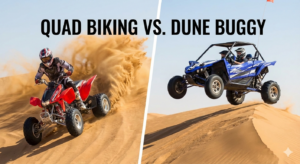
6. Scenarios: Which Ride fits Your Vibe?
Still undecided on the Quad biking vs. Dune Buggy question? Let’s look at some common rider profiles.
The Adrenaline Junkie Solo Traveler
Choice: Quad Bike (High CC). You want the rawest connection. You want to feel the danger and master the machine through your own physical exertion. The buggy feels too safe, too insulated for you. You want the wind screaming in your helmet as you wrestle a 700cc Raptor up a dune face.
The Couple on a Romantic (but adventurous) Date
Choice: Dune Buggy (2-Seater). You want to experience the thrill together, side-by-side. You want to be able to shout “Did you see that?!” to your partner as you crest a dune at sunset. Putting your partner on a separate quad behind you isn’t the shared experience you are looking for.
The Family with Younger Teenagers
Choice: Dune Buggy (4-Seater). Dad or Mom drives, and the kids are safely strapped into the back seats in harnesses within a roll cage. It’s the only way to safely get the whole family into the heart of big dunes at speed.
The Driver with a Fear of Flipping
Choice: Dune Buggy. While buggies can flip, they feel much more secure. The psychological safety net of the roll cage and the familiar car-like controls significantly lowers anxiety levels compared to feeling perched precariously on top of a quad.
The Budget Backpacker
Choice: Quad Bike (Standard CC). You want the desert experience and the photo opportunity without blowing your entire trip budget in one hour. The standard quad tour delivers the best bang for your buck.
7. Essential Gear for Both Machines
Regardless of who wins the Quad biking vs. Dune Buggy debate for you, the desert demands respect. The gear requirements are surprisingly similar for both.
-
Helmet (Non-Negotiable): Whether in a cage or on a saddle, a DOT-approved helmet is essential. Sand can hide rocks, and rollovers happen.
-
Goggles: Sunglasses are not enough. The fine silica dust of the desert will bypass sunglasses instantly. You need sealed motocross goggles to see where you are going.
-
Face Scarf/Balaclava: To keep the sand out of your mouth and nose.
-
Closed-Toe Shoes: Never ride in flip-flops. You need protection for your feet, especially on a quad where your feet are near the engine and moving wheels.
-
Long Sleeves and Pants: To protect from sunburn and “sand-rash” if you fall.
8. Conclusion: Making Your Final Decision
The battle of Quad biking vs. Dune Buggy has no single victor; it only has a winner for your specific needs today.
If you crave a physically engaging, raw, solitary challenge where you are the master of your machine’s balance, the quad bike is your steed. It is the closest you will get to riding a wild animal in the desert.
If you desire high-speed thrills, the comfort of suspension that swallows bumps, the safety of a roll cage, and the joy of a shared experience with a friend or partner right next to you, the dune buggy is the undisputed champion.
Our advice? Be honest about your physical fitness, your risk tolerance, and your budget. Don’t let ego push you onto a powerful quad if you’d feel safer in a buggy. Conversely, don’t hide in a buggy if your soul is craving the exposed rush of the quad.
Whichever you choose, the desert awaits. The feeling of cresting a towering dune and looking out over an endless expanse of sand is a life-changing moment, regardless of the number of wheels or the type of seat that got you there.