
The Incredible History of the Tanoura Dance Explained
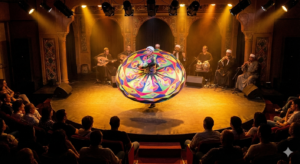
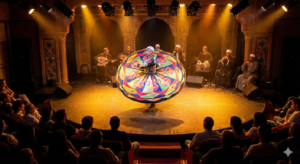
The lights dim, the rhythmic beat of traditional drums fills the air, and a figure steps onto the stage. Cloaked in layers of vibrant, multi-colored fabrics, the performer begins to turn. Slowly at first, then faster and faster, until they become a blurring whirlwind of color and motion. This is the Tanoura dance, a spectacle that has captivated audiences for centuries.
Far more than just a dazzling display of physical endurance and coordination, the Tanoura dance is a performance steeped in deep spiritual meaning and rich historical tradition. It is a bridge between the earthly and the divine, a vibrant expression of Egyptian culture that has its roots in ancient mystical practices. To witness a Tanoura dance is to be pulled into a hypnotic journey that transcends mere entertainment, offering a glimpse into a philosophy that sees the entire universe in a state of constant, ecstatic motion.
In this comprehensive article, we will peel back the colorful layers of the Tanoura dance to uncover its secrets. We will explore its origins amongst the Sufi mystics, trace its evolution into a beloved Egyptian folk art, decode the powerful symbolism woven into every spin, and discover why this mesmerizing performance continues to hold such power over spectators today.
What is the Tanoura Dance?
At its core, the Tanoura dance is a form of folkloric dance indigenous to Egypt, though its origins are deeply deeply intertwined with the wider Islamic world. The word “Tanoura” itself is Arabic for “skirt,” referencing the most defining visual element of the performance: the large, weighted, and vividly decorated skirts worn by the dancer.
Unlike many other forms of dance that rely on varied steps and complex choreography across a stage, the primary movement in the Tanoura dance is spinning. The dancer, known as a tanannir, whirls continuously in a counter-clockwise direction for an extended period, often up to 30 minutes or more, without becoming dizzy or losing balance. This feat of physical control is astounding in itself, but it is the manipulation of the costumes while spinning that creates the visual magic.
A Tanoura dance performance is a riot of color. The skirts are not just bright; they are often patterned with geometric designs, applique, and sometimes even LED lights in modern interpretations. As the dancer spins, centrifugal force causes the heavy skirts to flare out, creating a perfect, floating disc of color around their body. The dancer may wear multiple skirts layered on top of one another, which they can manipulate mid-spin, raising them above their head to create shapes like a lantern or a blossoming flower, or even detaching them to hold a spinning disc of fabric in each hand.
While often performed solo, the Tanoura dance can also be a group performance, with multiple dancers spinning in unison, creating a tapestry of moving color on stage. The performance is almost always accompanied by traditional Arabic music, featuring instruments like the tabla (drum), mizmar (oboe), and rebab (string instrument), whose rhythmic crescendo matches the increasing speed and intensity of the dancer’s spins. It is a total sensory experience, where sound, color, and movement converge to create a hypnotic effect on the audience.
The Spiritual Roots: Sufism and the Whirling Dervishes
To truly understand the Tanoura dance, one must look beyond Egypt to the heart of Islamic mysticism known as Sufism. The dance is a direct descendant of the Sema ritual practiced by the Mevlevi Order of Sufis, often known in the West as the “Whirling Dervishes.”
Sufism is a mystical dimension of Islam that emphasizes the inward search for God and the purification of the soul. Its followers seek to find divine love and knowledge through direct personal experience. In the 13th century, the great Persian poet, jurist, and theologian Jalal ad-Din Muhammad Rumi founded the Mevlevi Order in the city of Konya, in modern-day Turkey. Rumi believed that music, poetry, and dance were paths to reaching God. For him, the act of whirling was not a performance but a form of active meditation and worship.
The fundamental philosophy behind the Sufi whirling, which gave birth to the Tanoura dance, is the concept of unity. Sufis believe that everything in the universe, from the smallest atom to the largest galaxy, is in a state of constant revolution. By spinning, the dervish seeks to align themselves with this cosmic rhythm. The whirling is a journey of spiritual ascent. The dervish is a traveler on a path from the material world to the spiritual world and back again.
In the traditional Turkish Sema, the dancers wear long white robes symbolizing a funeral shroud (the death of the ego) and tall conical hats representing a tombstone. Their spinning is slow, controlled, and deeply solemn. They revolve around their own axis while also orbiting the Sheikh (the spiritual leader), mirroring the planets orbiting the sun. Through this physical act, they seek to abandon their personal desires and ego, dissolve into the divine presence, and return to earth as more mature, perfect beings able to serve all of creation with love.
This profound spiritual ritual is the ancestor of the Tanoura dance. While the Egyptian version has evolved into a more colorful and energetic folk art, the core principle of spinning to achieve a transcendent state remains its beating heart. The connection is a powerful reminder that the Tanoura dance is more than just a spectacle; it is a performance with a soul, rooted in a centuries-old quest for divine connection. You can learn more about the Mevlevi Order and their practices on their official websites or through reputable historical sources like Wikipedia.
The Egyptian Evolution: How Tanoura Dance Became a Cultural Icon
The journey of the whirling ritual from the Sufi lodges of Turkey to the stages of Egypt is a fascinating tale of cultural adaptation and evolution. While the exact timeline is debated by historians, it is widely believed that Sufi practices, including whirling, were introduced to Egypt during the era of the Fatimid Caliphate (around the 10th to 12th centuries AD) and later reinforced during the Ottoman rule.
Egypt, with its rich history of art, music, and performance, has a unique ability to absorb cultural influences and remold them into something distinctly its own. As the Sufi whirling ritual took root on Egyptian soil, it began to transform. The solemn, monochromatic Sema of the Mevlevi order started to blend with the vibrant, celebratory spirit of Egyptian folk traditions.
Over time, the performance shifted from a purely religious ritual carried out within the confines of Sufi orders into a form of public entertainment and cultural expression. The all-white attire of the Turkish dervishes was replaced by the vividly colored, multi-layered skirts that define the Tanoura dance today. The movements became more vigorous, athletic, and showman-like. The music shifted from solemn religious chants to upbeat, rhythmic Egyptian folk melodies.
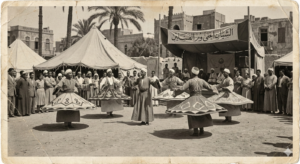
This evolution was not a degradation of the original ritual but a reinterpretation of it through an Egyptian lens. The Tanoura dance emerged as a celebration of life, color, and joy, while still retaining the underlying spiritual symbolism of the spin. It became a staple of religious festivals (Moulids), weddings, and national celebrations.
The modern form of the Tanoura dance, with its focus on skirt manipulation and visual spectacle, was further developed in the 20th century by Egyptian choreographers and troupe leaders who sought to codify it as a national folk dance. They introduced elements like the use of multiple skirts and handheld props to enhance the theatricality of the performance. Today, the Tanoura dance is recognized globally as an icon of Egyptian culture, a brilliant fusion of mystical heritage and folkloric artistry that continues to evolve while honoring its past.
Symbolism in Motion: Decoding the Tanoura Dance Performance
Every element of a Tanoura dance performance, from the direction of the spin to the colors on the skirt, is laden with symbolic meaning derived from its Sufi origins. Nothing is arbitrary. For the informed spectator, the dance is a complex visual language speaking of spiritual truths.
The Dancer as a Spiritual Conduit
The dancer is not merely a performer but a symbol of humanity’s potential for connection with the divine. The very act of spinning is a representation of the human soul’s journey. The counter-clockwise direction of the spin is significant; it is the same direction used by Muslims when circumambulating the Kaaba in Mecca during the Hajj pilgrimage. It also mirrors the rotation of planets and the spin of electrons around a nucleus, reflecting the Sufi belief in a unified cosmic order.
As the dancer whirls, you will often see their arms moving into specific positions. The most iconic pose is with the right arm raised toward the heavens with the palm facing up, and the left arm pointing toward the earth with the palm facing down. This is a powerful symbol of the dancer acting as a conduit between the two realms. The right hand receives divine grace, blessings, and energy from God, which passes through the dancer’s heart and is transmitted down to the earth and all humanity through the left hand. It is a beautiful physical manifestation of the Sufi ideal of being an instrument of God’s love in the world.
The Burden and Beauty of the Skirt
The tanoura itself, the heavy, colorful skirt, is perhaps the most potent symbol in the entire performance. In its original Sufi context, the white robe represented the ego’s funeral shroud. In the Egyptian Tanoura dance, the symbolism has expanded.
The sheer weight of the skirt which can sometimes weigh up to 10 or 15 kilograms due to its many layers and heavy fabric—represents the burdens of the material world. It symbolizes the ego, worldly attachments, sins, and the physical body itself that weighs down the human soul. By spinning with this heavy burden for an extended time, the dancer demonstrates discipline, endurance, and the spiritual strength needed to control and overcome these worldly attachments.
When the dancer unties the waist strap and lifts the spinning skirt over their head, it is a moment of profound symbolism. It represents the soul’s liberation from the confines of the body and the ego. It is an act of shedding the material world to experience a moment of spiritual ascension and closeness to the divine.
The vibrant colors of the skirt are also symbolic. While interpretations can vary, they often represent the different elements of nature or different spiritual states. For example, green can represent the earth or paradise, blue the sky or the divine, red for fire or divine love, and yellow for light or the desert. The blending of these colors as the skirt spins represents the unity of all creation under God.
The Language of the Spin
The spin itself is a form of active meditation. For the dancer, the constant rotation induces a trance-like state that allows them to detach from their immediate surroundings and focus inward. The centrifugal force pushing the skirt outwards is seen as a physical manifestation of spiritual energy radiating from the center.
In some performances, the dancer will manipulate the skirt to create different shapes. Holding one side up to cradle it like a baby can symbolize birth and new life. Holding it high like a lantern can represent the light of divine knowledge guiding the way through the darkness of ignorance. Every gesture is a word in a silent, spiritual poem written in motion.
While a modern audience may cheer for the visual spectacle, the underlying message of the Tanoura dance remains one of deep spiritual striving a human being’s attempt to cast off the temporary and touch the eternal through the power of ecstatic movement.
Tanoura Dance Today: From Sufi Ritual to Global Stage
Today, the Tanoura dance occupies a unique space, straddling the worlds of sacred ritual, folk art, and tourist entertainment. It has become one of Egypt’s most recognizable cultural exports, performed on stages around the world.
In Egypt, you can witness the Tanoura dance in a variety of settings. It is a highlight of many evening entertainment programs on Nile cruise ships and at desert safari camps, where it serves to introduce tourists to Egyptian folklore. These performances are often high-energy and theatrical, designed to dazzle with lights and rapid costume changes.
For a more traditional and atmospheric experience, many visitors flock to cultural centers like the historic Wekalet El Ghouri in Islamic Cairo. Here, troupes perform the Tanoura dance as part of a larger showcase of Egyptian folk arts, often in a setting that feels closer to its historical roots. These performances strike a balance, honoring the spiritual origins while presenting a polished artistic show.
The dance has also continued to evolve. Contemporary Tanoura artists experiment with new elements to keep the performance fresh and engaging for modern audiences. The use of LED-lit skirts, which turn the dancer into a spinning top of streaking light in the dark, is a popular modern innovation. Some performers have pushed the physical boundaries of the dance, spinning for incredibly long durations or manipulating an ever-increasing number of skirts and props.
Despite these commercial and modern adaptations, the essence of the Tanoura dance has not been lost. Even in a hotel ballroom, when a skilled dancer begins their mesmerizing spin, a hush often falls over the crowd. The primal power of the movement, the hypnotic rhythm of the music, and the explosion of color still have the ability to touch something universal in the human spirit.
The Tanoura dance serves as a vital link to Egypt’s past, keeping alive a tradition that reflects the country’s unique blend of Islamic heritage, African rhythms, and Mediterranean influences. It is a living, breathing art form that continues to captivate and inspire, proving that the ancient quest for connection—whether with the divine, with culture, or with fellow human beings—is as relevant today as it was centuries ago.
Conclusion
The Tanoura dance is a magnificent tapestry woven from threads of history, spirituality, and artistry. From its solemn origins in the Sufi Sema rituals of the 13th century to its explosion of color on the contemporary stages of Egypt, it has been a journey of transformation and endurance.
It is a dance that defies simple categorization. It is a physical feat that leaves audiences breathless, a vibrant folk art that celebrates Egyptian identity, and a deeply symbolic performance that speaks of the soul’s eternal quest for the divine. To watch a Tanoura dance is to witness a beautiful paradox: a human being weighed down by heavy skirts yet appearing to float, a whirlwind of chaotic motion that creates a perfect, serene circle of color.
Ultimately, the Tanoura dance is a testament to the enduring power of human expression. It reminds us that through movement, music, and devotion, we can transcend the mundane and touch something truly extraordinary. Whether you see it as a dazzling cultural show or a profound spiritual metaphor, the Tanoura dance is an unforgettable experience that leaves a lasting imprint on the soul, inviting us all to join in the eternal, ecstatic spin of the universe.

