
Secure Dubai Safari Regulations
Secure Dubai Safari Regulations are the cornerstone of the UAE’s tourism industry, transforming what looks like a wild ride into a meticulously controlled and professional experience. For anyone visiting the Middle East, the desert is an irresistible draw, but safety is often the first question on a traveler’s mind. In 2025, Dubai has doubled down on its safety protocols to ensure that every visitor—from thrill-seekers to families, can enjoy the dunes with absolute confidence.
Why Safety is the Real Luxury
In a city known for the “biggest” and “best” of everything, safety is the quiet luxury that makes the Dubai experience possible. The desert is a beautiful but unforgiving environment. To manage the risks associated with off-road driving, the Dubai government has implemented a complex web of Secure Dubai Safari Regulations. This article provides a deep dive into the 10 vital safety facts that every tourist should know before they buckle up for their desert adventure.
1. The RTA Mandatory Safari Driver Permit
The most important factor in desert safety isn’t the car; it’s the person behind the wheel. Under current Secure Dubai Safari Regulations, every commercial driver must hold a specialized “Safari Driver” license issued by the Roads and Transport Authority (RTA).
This is not a simple driving test. Drivers must undergo a rigorous 5-day training course that covers:
-
Dune Reading: Understanding how wind and shadows change the hardness of the sand.
-
Emergency Recovery: How to safely extract a vehicle if it becomes “stuck” or “beached.”
-
Passenger Care: Managing the comfort levels of people inside the vehicle to prevent motion sickness or distress.
2. Advanced Vehicle Roll-Over Protection (ROP)
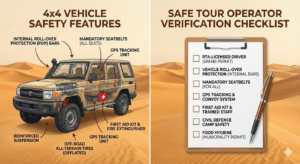
While Toyota Land Cruisers are naturally robust, they are not allowed onto the dunes in their factory-standard condition. To comply with Secure Dubai Safari Regulations, vehicles must be fitted with internal roll cages or reinforced high-strength steel bars.
These bars are often hidden behind the interior trim, but their presence is mandatory. They ensure that in the highly unlikely event of a vehicle rolling over, the cabin remains intact, protecting the passengers’ survival space. Furthermore, every car is inspected annually by the RTA specifically for off-road fitness.
3. Precision Tire Pressure Management
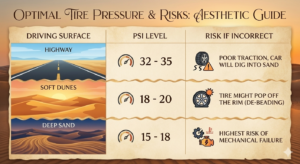
One of the most technical aspects of Secure Dubai Safari Regulations involves tire pressure. High-pressure tires used on the highway would bounce and slide dangerously on soft sand.
Before the “dune bashing” begins, drivers stop at a deflation point to lower the tire pressure to approximately 18-20 PSI. This increases the tire’s “footprint,” allowing it to float over the sand rather than dig into it. This simple mechanical adjustment is a legal requirement that prevents the vehicle from flipping or losing control on steep slopes.
Tire Pressure Comparison
4. Compulsory Safety Briefings and Seatbelt Enforcement
According to the latest Secure Dubai Safari Regulations, a safari cannot begin until a safety briefing is conducted. Your driver is legally obligated to ensure that:
-
Seatbelts are Fastened: This is the #1 life-saving measure.
-
Loose Items are Secured: Cameras and phones can become projectiles during a sharp turn.
-
Physical Awareness: Passengers are taught the correct posture to avoid neck strain during the “dips” of the dunes.
5. Health Restrictions and Passenger Safety Zones
To maintain the highest Secure Dubai Safari Regulations, certain travelers are advised to skip the “High Dune” portion of the trip. Most operators now offer a “Soft Drive” or “Direct to Camp” option for:
-
Pregnant Women: The sudden movements of dune bashing pose a risk.
-
Back/Neck Injuries: The vertical impact of landing a jump can exacerbate existing spinal issues.
-
Heart Conditions: The adrenaline spikes and physical nature of the ride are not suited for those with cardiac concerns.
6. The Convoy System and GPS Monitoring
You will rarely see a single car in the middle of the desert. Secure Dubai Safari Regulations encourage (and in many protected zones, mandate) a convoy system.
-
Mutual Support: Cars travel in groups of 3 to 10. If one vehicle has a flat tire or mechanical issue, the others are there to provide immediate assistance.
-
GPS Tracking: Modern safari fleets are equipped with real-time GPS. The company’s control room knows the exact location of the vehicle, ensuring that help can be dispatched if a driver deviates from the approved path.
7. Fire Safety and Civil Defence Inspections
The desert camp, with its traditional carpets and wooden structures, is a beautiful setting, but it requires strict fire safety. Secure Dubai Safari Regulations demand that camps undergo regular inspections by Dubai Civil Defence.
Every camp must have:
-
Clearly Marked Fire Extinguishers: Placed near kitchens and the central stage.
-
Emergency Exits: Clearly marked pathways leading to the vehicle pick-up area.
-
Stage Safety: A “buffer zone” between fire dancers and the audience to prevent accidents during performances.
8. Dubai Municipality Food Hygiene Standards
Food safety is a critical part of Secure Dubai Safari Regulations. Because the kitchens are in the middle of the desert, maintaining the cold chain is vital.
-
Temperature Control: Meats are transported in refrigerated trucks and cooked immediately on live charcoal to ensure freshness.
-
Water Safety: Only factory-sealed bottled water and canned sodas are permitted for guest consumption.
-
Hygiene Permits: Every desert kitchen must have a valid permit from the Dubai Municipality Food Safety Department.
9. Animal Welfare and Camel Riding Safety
Safety extends to the animals as well. To ensure a safe experience for riders, camels are handled by experts who understand their behavior.
-
Mounting Safety: Handlers hold the camel’s head and neck as it stands up, preventing the sudden “jolt” that can unseat a rider.
-
Rest Periods: Regulations ensure that animals are not overworked in the heat, which keeps them calm and predictable for tourists.
10. First Aid Training and Equipment
Every safari vehicle is essentially a mini-mobile clinic. Under Secure Dubai Safari Regulations, every vehicle must carry a certified first aid kit. More importantly, the drivers are trained in:
-
Heat Stroke Recognition: Identifying the early signs of dehydration or overheating.
-
CPR and Basic Life Support: Ensuring that they can manage any medical emergency until help arrives.
-
Communication: Every car has a two-way radio to call for emergency medical evacuation if necessary.
Peace of Mind in the Golden Sands
The desert is a place of wonder, and thanks to the Secure Dubai Safari Regulations, it is also a place of safety. By choosing a licensed operator that follows these 10 vital protocols, you ensure that your memories will be defined by the beauty of the sunset and the thrill of the dunes, rather than by a safety mishap.
Whether it’s the reinforced roll bars of the 4×4 or the temperature-controlled BBQ buffet, Dubai’s commitment to safety is what makes the desert safari the world’s most popular desert adventure.

