Camera Allowed During Desert Safari
Camera Allowed During Desert Safari: Capture every breathtaking moment of your Arabian journey with our incredible guide on photography rules, gear protection, and expert tips for 2026.
Introduction: Is a Camera Allowed During Desert Safari?
Camera Allowed During Desert Safari queries are among the most common questions from international travelers planning their visit to the UAE. The short and exciting answer is: Yes, cameras are absolutely allowed and highly encouraged! The desert landscape, with its undulating dunes and dramatic lighting, is a photographer’s paradise. Whether you are carrying a high-end DSLR, a mirrorless setup, or just the latest smartphone, having a Camera Allowed During Desert Safari ensures you can immortalize the stunning vistas of the Arabian wilderness.
However, while a Camera Allowed During Desert Safari is a standard policy, there are nuances to consider. In 2026, photography in the UAE is governed by both hospitality and strict privacy regulations. Understanding where to point your lens—and where not to—is the difference between a successful photoshoot and a legal complication. This 2100-word guide will walk you through everything you need to know about maximizing your photography opportunities while respecting local customs and protecting your expensive gear from the harsh desert elements.
Why Photography is Essential for Your Journey
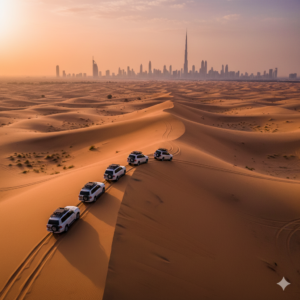
The Arabian desert is a place of ethereal beauty that words often fail to describe. From the deep ochre sands of Al Khatim to the pale gold ridges of Lahbab, the visual diversity is staggering. Having a Camera Allowed During Desert Safari allows you to tell a story that goes beyond a simple social media post. It allows you to capture the texture of the sand, the majestic flight of a falcon, and the genuine joy of an Abu Dhabi Desert Safari.
In the age of digital storytelling, your photos serve as a digital heritage. For professional creators, the fact that there is a Camera Allowed During Desert Safari means they can produce high-quality content that rivals national geographic standards. For families, it means capturing the look of wonder on a child’s face during their first camel ride. Without the freedom of a Camera Allowed During Desert Safari, the experience would be fleeting; with it, the desert lives on in your home forever.
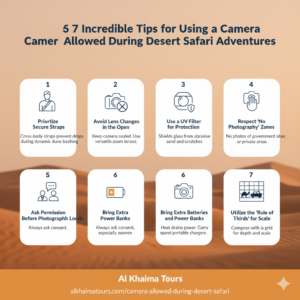
Top 7 Tips for Using a Camera Allowed During Desert Safari
1. Prioritize Secure Straps
During the high-intensity portion of the trip, specifically the Extreme Dune Bashing Adventure, the vehicle will experience significant movement. Even though a Camera Allowed During Desert Safari policy exists, the car won’t stop for a dropped lens. Use a cross-body strap to ensure your camera stays attached to you at all times.
2. Avoid Lens Changes in the Open
The desert wind is constant, carrying microscopic silt. When using a Camera Allowed During Desert Safari, try to use a versatile zoom lens (like a 24-70mm or 24-105mm). Opening your camera body to change lenses in the dunes is an invitation for sand to ruin your sensor.
3. Use a UV Filter for Protection
A UV filter is a cheap insurance policy for your Camera Allowed During Desert Safari. Sand particles can be abrasive; it is much better to scratch a replaceable $20 filter than a $2,000 lens element.
4. Respect “No Photography” Zones
While a Camera Allowed During Desert Safari applies to the dunes and the camp, it does not apply to government buildings, military installations, or certain restricted areas near the border. Always check with your guide before shooting near infrastructure.
5. Ask Permission Before Photographing Locals
UAE culture is deeply private. If your Camera Allowed During Desert Safari plan includes portraits of local Bedouins or other guests, always ask for permission first. It is considered highly disrespectful to take photos of women without explicit consent.
6. Bring Extra Batteries and Power Banks
The heat of the desert can drain lithium-ion batteries faster than usual. If you plan on using a Camera Allowed During Desert Safari all afternoon and into the night, bring at least one spare battery and a rugged power bank.
7. Utilize the “Rule of Thirds” for Scale
The desert can look flat in photos. To make the most of your Camera Allowed During Desert Safari, place a person, a camel, or a 4×4 vehicle in the foreground or on the “third” lines to give the viewer a sense of the massive scale of the dunes.
Understanding Local Privacy Laws and Ethics
While you have a Camera Allowed During Desert Safari, you must be aware of the UAE’s strict privacy laws. According to the UAE Government Portal, taking photos of people without their consent, especially in a way that could be perceived as invasive, can lead to fines or legal action.
In the context of a Camera Allowed During Desert Safari, this usually applies to the communal areas of the camp. Most people are happy to be in the background of a wide shot, but “paparazzi-style” photography of other guests is a breach of etiquette. Always remember that the desert is a shared space of serenity. Your Camera Allowed During Desert Safari should be a tool for appreciation, not intrusion.
Best Gear for a Camera Allowed During Desert Safari
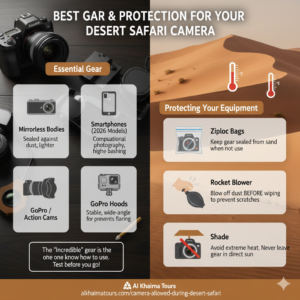
Choosing the right equipment is vital for a successful shoot. If you are serious about your Camera Allowed During Desert Safari, consider the following kit:
-
Mirrorless Bodies: They are generally better sealed against dust than older DSLRs.
-
Smartphones: In 2026, flagship phones have incredible computational photography that handles the high-contrast light of the desert beautifully.
-
GoPro/Action Cams: Perfect for the dune bashing segment. Mount it to the window or roll cage (with permission) to get stable, wide-angle footage.
-
Lens Hoods: Essential for blocking the harsh desert glare that causes unwanted flaring.
When you have a Camera Allowed During Desert Safari, the most “Incredible” gear is the one you know how to use. Don’t bring a brand-new camera you haven’t tested; the desert is an unforgiving place to learn menu settings.
Protecting Your Equipment from Sand and Heat
The two biggest enemies of a Camera Allowed During Desert Safari are heat and sand. Sand is everywhere—it’s in the air, on your clothes, and in your shoes. Even a “weather-sealed” camera can suffer if sand gets into the zoom ring or the battery compartment.
Protection Strategies:
-
Ziploc Bags: When not in use, keep your Camera Allowed During Desert Safari in a sealed bag inside your padded camera bag.
-
Rocket Blower: Use this to blow off dust. Never rub the lens with a cloth until you have blown off the loose grit, or you will “sandpaper” the glass.
-
Shade: Never leave your camera on the car dashboard. The 40°C+ heat can cause the internal electronics to fail or the lubricants in the lens to thin out.
Alt Text: A professional photographer using a rocket blower to clean his Camera Allowed During Desert Safari after a shoot.
Capturing the “Golden Hour” in the Dunes
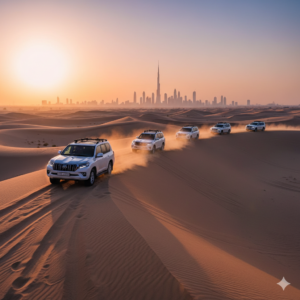
The highlight of any Camera Allowed During Desert Safari is the Golden Hour—the hour before sunset. During this time, the sun is low on the horizon, casting long shadows that define the ridges of the dunes. The light turns a deep, warm honey color that is incredibly flattering for portraits.
To master the Golden Hour with your Camera Allowed During Desert Safari, look for “Backlighting.” Position the sun behind your subject (like a camel) to create a glowing rim-light effect. This adds a “Spectacular” quality to your photos that is unique to the Arabian desert.
Video and Drones: Is that Camera Allowed During Desert Safari?
While a standard Camera Allowed During Desert Safari includes video cameras and hand-held devices, drones are a different story. In the UAE, drone laws are very strict. As of 2026, hobbyist drone flying is heavily restricted in many tourism zones to protect privacy and aviation safety.
If you wish to use a drone-mounted Camera Allowed During Desert Safari, you must:
-
Register with the General Civil Aviation Authority (GCAA).
-
Obtain a permit for the specific location and date.
-
Ensure the tour operator, like Al Khaima Tours, allows drone use at their camp.
Without these permits, your drone is NOT a Camera Allowed During Desert Safari and could be confiscated by authorities.
The Role of Professional Guides at Al Khaima Tours
The guides at Al Khaima Tours understand the importance of your Camera Allowed During Desert Safari. They are trained to know the best vantage points in the dunes. A good guide will stop the vehicle at a ridge where the light is perfect and the sand is “virgin” (without footprints).
They also act as informal photography assistants! Many guides are experts at taking that “Incredible” shot of you jumping off a dune or holding a falcon. They understand that a Camera Allowed During Desert Safari is part of the guest experience and will go the extra mile to ensure you get the shots you want safely. If you’re interested in how these professionals are trained, you can read about the Desert Safari Driving License requirements.
Technical Settings for Desert Landscapes
When you have a Camera Allowed During Desert Safari, you need to adjust for the brightness of the sand. Sand acts like snow; it reflects a massive amount of light, which can “trick” your camera’s meter into underexposing the shot, making the sand look gray.
-
Exposure Compensation: Dial in +0.7 or +1.0 to keep the sand looking bright and white/gold.
-
Aperture: Use f/8 or f/11 for landscapes to ensure everything from the foreground ripples to the distant horizon is sharp.
-
ISO: Keep it at the base (ISO 100) to avoid digital noise, as there is plenty of light available for your Camera Allowed During Desert Safari.
-
White Balance: Set it to “Cloudy” or “Shade” to enhance the warm, golden tones of the desert.
Conclusion: Preserving Your Memories
Having a Camera Allowed During Desert Safari is a privilege that allows you to connect with the landscape on a deeper level. By following the 7 tips provided, respecting local laws, and taking proactive steps to protect your gear, you can ensure that your photography session is both “Incredible” and stress-free.
The desert is a canvas of light and shadow, waiting for you to capture its secrets. Whether you are using a professional rig or a smartphone, your Camera Allowed During Desert Safari is the most important tool in your travel kit. It bridges the gap between the ancient sands and your modern life, allowing the magic of the dunes to live on long after the sand has been shaken from your shoes.
Trust in operators like Al Khaima Tours to provide the perfect backdrop for your masterpiece. From the first click of the shutter to the final sunset shot, your desert photography journey is destined to be spectacular.

