Do Desert Safari Park Sharjah Have Wheelchairs?” is one of the most common and critical inquiries made by travelers planning a desert safari experience in the United Arab Emirates. For wheelchair users, seniors, and guests with limited mobility, this question is not merely about convenience; it is about ensuring comfort, safety, dignity, and ease of movement in one of the UAE’s most iconic, yet naturally challenging, tourism environments.
Desert safaris stand as one of the most unforgettable and iconic tourism experiences in the UAE. Visitors from around the globe are drawn to the endless expanse of golden dunes, the dramatic spectacle of desert sunsets, the welcoming atmosphere of traditional Arabian camps, captivating live cultural performances, and the sheer delight of a generous barbecue dinner under the vast, open desert sky. While the memories created are priceless, the inherent nature of the desert—with its soft, shifting sand, uneven terrain, and remote locations—presents unique and natural challenges for accessibility. For this reason, accessibility must be thoughtfully and realistically considered long before any booking is confirmed.
This comprehensive guide is dedicated to providing a clear, detailed, and honest answer to whether Desert Safari Park Sharjah provides wheelchairs. Furthermore, it delves into what “wheelchair friendly” truly means in a desert setting, offers a critical comparison of accessibility standards in Sharjah versus Dubai and Abu Dhabi, identifies which activities wheelchair users can enjoy safely, details those that should be avoided, and emphasizes why the choice of an experienced and ethical tour operator, such as Al Khaima Tours, plays a critical and defining role in creating a truly inclusive, stress-free, and memorable desert safari experience for all guests.
Understanding accessibility in this context is never about limiting the spirit of adventure. It is fundamentally about setting realistic and well-informed expectations, enabling guests to make confident booking decisions, and ultimately ensuring that every single visitor can fully immerse themselves in the magic and tranquility of the desert without unnecessary discomfort, undue risk, or logistical stress.
Understanding Desert Safari Accessibility in Sharjah
Sharjah desert safari experiences are consciously designed to be a showcase of traditional Emirati culture, deep-rooted values, and genuine Arabian hospitality. The structure of most standard tours is similar: guests are picked up from their hotel in a four-wheel-drive vehicle (4×4), transported into the heart of the desert, where they have the option of dune bashing, before finally arriving at a desert camp. This camp serves as the hub for the evening’s activities, including cultural entertainment and the main dining event. Camps are typically arranged with distinct areas for seating, a performance stage, buffet counters, and designated restroom facilities.
The Primary Accessibility Challenge: Natural Terrain
The foremost challenge to accessibility in Sharjah’s desert environment stems directly from the natural desert terrain itself. The loose, soft sand, the inherently uneven ground, and the lack of permanent, rigid infrastructure make it extremely difficult, and often prohibited by environmental regulation—to install features common in urban environments. Unlike city attractions, desert safari camps typically operate in environmentally sensitive, protected desert areas where construction options, such as pouring concrete for ramps or paving walkways, are severely limited.
Wheelchair Friendly with Assistance (The Sharjah Standard)
Despite the limitations posed by the soft sand, many Sharjah desert safari camps strive to be “wheelchair friendly with assistance.” This is the crucial distinction for the Emirate. Camps are often set up on areas of compacted sand to offer the firmest possible ground surface. More importantly, camp staff members are frequently trained and dedicated to helping guests navigate the main areas safely, whether assisting with pushing the wheelchair or steadying a guest using a walking aid. With sufficient advance notice to the tour operator, seating and dining arrangements can almost always be adjusted to support wheelchair users in a comfortable and accommodating manner.
The Direct Answer: Do Desert Safari Park Sharjah Have Wheelchairs?
The question, “Do Desert Safari Park Sharjah Have Wheelchairs?” requires a clear, unambiguous, and honest answer to set the right expectation.
In the vast majority of cases, desert safari parks and operators in Sharjah do not provide wheelchairs as part of their standard amenities or on-site camp facilities.
Guests who rely on a wheelchair for mobility are generally expected to bring their own personal wheelchair for the duration of the experience.
It is vital to stress that this policy does not mean that wheelchair users cannot enjoy a desert safari in Sharjah. On the contrary, many reputable camps warmly welcome wheelchair users, provide dedicated staff assistance throughout the evening, and ensure that the key dining and entertainment areas are navigable with help. The overall quality and ease of the experience, however, depend almost entirely on the specific layout of the chosen camp and the professionalism and communication of the tour operator.
Limited Options for Wheelchair Supply
If a guest absolutely requires a wheelchair to be supplied by the safari company, the options available in Sharjah are often extremely limited or non-existent. In situations demanding a supplied wheelchair and maximum accessibility infrastructure, Dubai-based desert safari operators typically offer better accessibility support, more modern, purpose-built facilities, and a higher chance of meeting this specific requirement.
“Wheelchair Friendly”
It is essential to understand that “wheelchair friendly” in a desert context does not equate to “fully wheelchair accessible” in the same way that a modern hotel, shopping mall, or international airport is designed. Instead, it refers to a set of practical and flexible arrangements implemented on site that are specifically designed to allow wheelchair users to fully enjoy the core, magical elements of the desert safari experience with dignity, comfort, and minimal stress.
In Sharjah desert safari camps, “wheelchair friendliness” typically incorporates the following elements:
-
Open, Uncluttered Layouts: Camp spaces are designed with wide paths and minimal obstacles.
-
Ground-Level Dining Spaces: Dining is often arranged at the ground level (on compacted sand) rather than on raised platforms.
-
Standard Table Seating: Operators will ensure comfortable chairs and tables are available instead of traditional low-lying floor cushions (known as majlis style seating).
-
Active Staff Assistance: Trained staff members are briefed to actively assist guests with transfers, movement, and navigation around the camp.
-
Optimal Seating for Shows: Seating for cultural performances (like the Tanoura dance, fire shows, and live music) is often arranged at the front or along clear, accessible pathways to maximize visibility and access.
While permanent ramps and paved paths remain rare, the combination of thoughtful, preventative planning and highly attentive service from a committed operator can significantly improve the comfort, safety, and inclusion for wheelchair users, transforming a potentially difficult outing into a seamless, welcoming cultural event.
Activities to Enjoy and Activities to Avoid
Wheelchair users can comfortably and safely enjoy many of the most popular and memorable parts of a desert safari without needing to participate in physically demanding adventure activities.
Must-Enjoy Accessible Highlights
-
Sunset Viewing: Watching the desert sunset is universally cited as a highlight. This can be enjoyed from flat, designated viewing areas immediately adjacent to the main camp.
-
Traditional Arabic Hospitality: The key cultural experience of being welcomed with fresh Arabic coffee (Gahwa) and dates can be enjoyed comfortably from seated positions.
-
Cultural Performances: Shows such as the graceful Tanoura dance, captivating fire shows, and traditional live music can all be enjoyed fully from the safe, seated positions arranged within the camp.
-
Photography and Dress-Up: Taking photographs in traditional Emirati costumes or against the stunning desert backdrop is entirely possible with the friendly and careful assistance of staff.
-
The BBQ Dinner: The generous barbecue dinner is often the centerpiece of the evening. With proper table seating and attentive table service (if needed for the buffet), wheelchair users can enjoy a full, delicious meal under the stars in a relaxed and welcoming atmosphere.
Activities Not Suitable for Wheelchair Users
Certain high-thrill desert safari activities are generally not suitable for wheelchair users due to safety and comfort considerations:
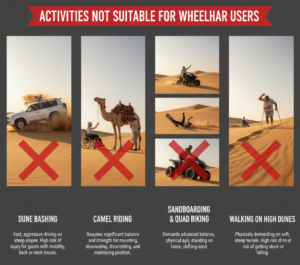
Recommendation: Professional operators like Al Khaima Tours can arrange direct, smooth transfers to the camp using easier, less aggressive desert tracks, allowing guests to bypass dune bashing entirely while still enjoying the complete evening program.
Restroom Accessibility: A Key Logistical Challenge
The issue of accessible toilets in a desert safari camp is one of the most significant logistical challenges.
Accessible toilets in Desert Safari Park Sharjah are available only in selected, usually premium, camps.
Many traditional or basic restrooms are built on small, raised wooden platforms or are surrounded by loose, deep sand, which makes independent access almost impossible for wheelchair users. When an accessible toilet is available, it is generally located near the main dining or seating areas. Even with a designated facility, staff assistance may still be required.
It is highly, strongly recommended to confirm the exact restroom accessibility and layout with the tour operator before booking, especially for guests who require frequent or independent access. In this area, the difference is often stark:
-
Dubai Desert Safari Camps generally offer far better and more reliable restroom facilities, often including western-style toilets, larger, more accommodating spaces, better lighting, and smoother, purpose-built access routes.
Comparison: Sharjah vs. Dubai and Abu Dhabi
The accessibility landscape varies across the Emirates, primarily driven by investment in high-end, inclusive tourism infrastructure.
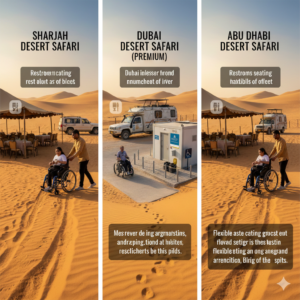
Dubai is widely regarded as the best destination in the UAE for wheelchair-friendly desert safari experiences. This is due to a higher capital investment in tourism infrastructure and a consistent focus on premium, inclusive guest services. Many of the best evening desert safari Dubai packages feature compacted pathways, purpose-built ramps, private vehicle options, and staff highly experienced in assisting guests with diverse mobility needs, making it the preferred choice for travelers seeking the most seamless experience.
The Critical Role of the Tour Operator
Choosing the right tour operator is not just important—it is absolutely essential for a successful accessible desert safari. Not all operators provide the same level of flexibility, staff training, or, most importantly, honesty regarding accessibility limitations.
A truly professional and ethical operator will:
-
Discuss limitations openly and explain what their specific camp can and cannot accommodate.
-
Make appropriate arrangements in advance, such as reserving table seating or briefing the staff.
-
Offer suitable transportation options, like a private, smooth transfer that avoids aggressive dune bashing.
Al Khaima Tours: A Model for Accessible Safaris
Al Khaima Tours, for instance, is noted within the industry for its strong commitment to safety, guest comfort, and inclusivity. While they may not provide the wheelchair itself, the company excels at the logistical and service elements required for an inclusive experience. Al Khaima Tours typically offers:
-
Private Transfers: Using experienced drivers who can provide personal support and select smoother, safer routes into the desert.
-
Wheelchair Friendly Camps: Access to camps with the best possible ground conditions and layouts.
-
Trained Support Staff: Dedicated team members who are briefed and ready to assist with movement, transfers, seating, and dining needs throughout the evening.
Practical Tips for Wheelchair Users
To ensure a positive and unforgettable desert safari experience, travelers with mobility challenges should follow these practical steps:
-
Always Inform the Operator: Communicate your specific mobility needs, the type of wheelchair you use (manual/electric, foldable), and any assistance you require before finalizing the booking.
-
Bring Your Own Wheelchair: As a standard rule, assume you must supply your own device.
-
Choose Private Tours: Private transfers are strongly recommended for the most comfortable and personalized experience, allowing for personalized routes and driver assistance.
-
Avoid Dune Bashing: Opt for the direct, smooth transfer to the camp to prioritize safety and comfort.
-
Confirm Restroom Access: Get explicit confirmation about the restroom facilities at the specific camp you will be visiting.
-
Allow Extra Time: Allocate a little extra time for getting on and off the vehicle and moving around the camp to maintain a relaxed, stress-free pace.
The recurring question, “Do Desert Safari Park Sharjah Have Wheelchairs?” highlights the growing and vital importance of accessible tourism in the UAE. The simple answer remains that wheelchairs are not usually provided in Sharjah desert safari camps. However, the comprehensive answer is that many Sharjah camps are successfully wheelchair friendly with assistance, offering a beautiful, culturally rich experience for guests with limited mobility.
While destinations like Dubai offer more advanced and infrastructure-heavy accessibility solutions, Sharjah and Abu Dhabi provide deeply authentic and accommodating desert experiences that are entirely enjoyable with careful, proactive planning. By setting realistic expectations, maintaining clear communication with your tour operator, and choosing a trusted and compassionate service provider like Al Khaima Tours, wheelchair users can confidently, comfortably, and safely immerse themselves in the unparalleled beauty, rich culture, and enduring magic of the Arabian desert. The desert is for everyone, and with the right preparation, the experience can be truly limitless.

