
Sandboarding for beginners
is an exhilarating experience, offering a unique blend of adrenaline, stunning landscapes, and the satisfying challenge of mastering a new terrain. Standing atop a massive golden dune, board strapped to your feet, staring down a slope that seems impossibly steep, is a moment of pure thrill. However, for many first-timers, that thrill is quickly replaced by the mouthful of grit that accompanies an ungraceful tumble down the face of the dune.
Falling is, inevitably, part of the learning curve in almost any board sport. Yet, in sandboarding, the fear of falling is often the primary barrier preventing beginners from truly enjoying the glide. The friction of the sand can make sudden stops jarring, and the shifting terrain can throw off even those experienced in surfing or snowboarding.
The good news is that while you might take a tumble or two, staying upright is not an impossible feat. By understanding the mechanics of sand, preparing your gear correctly, and adopting the right techniques, you can significantly reduce your time spent dusting yourself off and maximize your time carving down the slopes.
This extensive guide is designed specifically for sandboarding for beginners, breaking down the essential steps and mental shifts required to keep your balance. We will dive deep into the preparation, the stance, and the five crucial tips that will transform your first desert outing from a series of falls into a successful adventure.
Understanding the Beast: Why Sand is Different from Snow
Before we dive into the practical tips on sandboarding for beginners, it is vital to understand the medium you are trying to conquer. A common misconception is that if you can snowboard, you can easily sandboard. While there are transferable skills regarding balance, the physics of riding on sand are fundamentally different than riding on snow or water.
The Friction Factor
Snow is frozen water. When a snowboard glides over it, the pressure and friction create a microscopic layer of water, allowing for a near-frictionless glide. Sand, however, is abrasive. It is made of tiny granules of rock, coral, or shell. There is no melting layer to aid your descent.
Sand creates significant drag. This means that if your board isn’t properly prepared, or if your weight shifts too far forward, the nose of the board will dig instantly into the abrasive surface. This sudden deceleration is the number one cause of the dreaded “over-the-handlebars” faceplant for beginners. Understanding that you are constantly fighting friction is key to adopting the correct defensive posture.
The Shifting Terrain
Unlike a groomed ski slope or a paved skate park, a sand dune is alive. It shifts under your weight. As you carve a turn, you are pushing mounds of heavy sand out of the way. This requires more force and deliberate movement than turning on snow. Furthermore, wind can change the shape and texture of a dune in hours. A slope that was hard-packed in the morning might be soft and powdery by the afternoon, requiring real-time adjustments in your balance that challenge beginners.
Preparation Before the Dunes: Gear up for Success
Success in sandboarding for beginners starts in the parking lot, long before you strap in at the summit. If your equipment isn’t right, no amount of perfect technique will keep you upright.
The Right Board Matters
Do not attempt to use an old snowboard on sand dunes. Snowboards have metal edges designed to cut into ice; these edges will catch in the sand and send you flying. Furthermore, the base of a snowboard is too soft and will be ruined by the abrasive sand in one run.
Proper sandboards are constructed from harder woods or composites and feature a specialized, highly durable laminate base (often Formica or a similar material) designed to withstand abrasion and reduce friction. Ensure the bindings are secure and comfortable. Loose bindings lead to delayed reaction times, making it harder to correct your balance when the dune shifts beneath you.
Wax On, Sand Off: The Holy Grail of Gliding
This is perhaps the single most critical preparation step for sandboarding for beginners. Without wax, you will not glide; you will stick, jerk forward, and fall.
Because there is no melting water layer, you must create an artificial lubricant. Sandboard wax (paraffin-based, though sometimes specialized blends are available) must be applied generously to the base of the board before every run—yes, every run.
How to wax correctly:
-
Ensure the base is free of excess sand.
-
Rub the wax bar vigorously over the entire base until you see a visible, cloudy layer.
-
Pay extra attention to the nose and tail, and the edges where you’ll be turning.
-
Some riders buff the wax to create a smooth finish, while others leave it textured. For beginners, a thick, even coat is more important than a perfect polish. The wax provides the necessary slip to overcome drag, allowing for a smooth descent rather than a jerky, fall-inducing one.
Attire: Dressing for the Slide, Not Just the Sun
It’s the desert, so the temptation is to wear swim trunks and a tank top. Resist this urge. When you fall—and you will at least a few times—bare skin against coarse sand traveling at 20 mph results in “sand rash,” a painful abrasion similar to road rash.
For your first few times, prioritize protection over a tan.
-
Long Pants or Leggings: Essential for protecting knees and shins.
-
Long-Sleeved Shirt: Lightweight, breathable fabric protects elbows and forearms during a tumble.
-
Closed-Toe Shoes: While some experienced riders go barefoot in very soft sand, beginners should wear lightweight sneakers to protect toes from rocks hidden in the sand and to provide better leverage in the bindings.
-
Eye Protection/Goggles: Sand spraying into your eyes will instantly blind you, leading to a loss of balance. Sunglasses are okay, but snug-fitting goggles are better as they keep fine dust out.
-
A Buff or Bandana: To pull over your mouth and nose so you don’t inhale grit if you tumble.
Sandboarding for Beginners: 5 Essential Tips to Avoid Falling
Once you are geared up with a waxed board at the top of a dune, the real challenge begins. Implementing these five core techniques will drastically improve your stability and confidence.
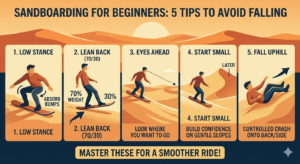
Tip 1: Master Your Athletic Stance
The root cause of many falls in sandboarding for beginners is standing too tall and stiff. A straight leg is a rigid pole that cannot absorb shock; if the board hits a bump or a soft patch of sand, that jolt travels straight up your stiff leg and throws your upper body off balance.
You need to adopt a low, dynamic, athletic stance. Think of the position a linebacker takes before a play, or a surfer catching a wave.
The Checklist for a Perfect Stance:
-
Feet Shoulder-Width Apart: Ensure your bindings are set at a comfortable distance that provides a stable base.
-
Deep Knee Bend: Bend your knees significantly. This lowers your center of gravity, making you much harder to topple over. Your legs act as shock absorbers, soaking up the undulations of the dune so your upper body remains steady.
-
Engage Your Core: A loose midsection leads to a wobbly upper body. Keep your abdominal muscles slightly engaged to connect your upper and lower body.
-
Relax Your Upper Body: While your legs and core are engaged, keep your shoulders and arms relaxed for balance. Avoid tensing up, which makes your movements jerky.
If you feel your legs beginning to burn, you are probably doing it right. A low stance requires physical effort, but it is the foundation of stability.
Tip 2: Weight Distribution acts as Your Steering Wheel (Lean Back!)
This is the counter-intuitive golden rule of sandboarding for beginners, and it is the hardest habit for snowboarders to break.
On snow on a steep slope, you often put weight on your front foot to initiate turns and control speed. On sand, putting weight on your front foot is an eject button.
Because of the high friction mentioned earlier, if your weight shifts forward, the nose of the board presses into the sand. Instead of gliding over it, the nose digs in. The board stops instantly, but your body keeps moving forward, resulting in a painful faceplant.
The 70/30 Rule: For beginners, aim to keep approximately 70% of your weight over your back leg and 30% over your front leg. You want the nose of the board slightly lifted so it planes on top of the sand, similar to a speedboat planing on water.
You must constantly consciously shift your hips backward. It will feel unnatural on a steep slope, as your instinct is to lean away from the fall line, but leaning back is what keeps the nose up and keeps you gliding. Steering is also done off the back foot, using your heel and toe pressure on the rear binding to guide the board like a rudder.
Tip 3: Look Where You Want to Go (The Power of Vision)
Target fixation is a real phenomenon in action sports. Your body naturally follows your line of sight. If you stare at your feet, your head drops, your shoulders roll forward, your weight shifts to the front of the board, and you fall.
If you stare at that one lone scrubby bush on the dune that you desperately want to avoid, you will almost certainly hit it.
To stay upright when learning sandboarding for beginners, you must keep your head up and your eyes focused down the dune toward your intended path. Look ahead to where you want to be in five seconds, not where you are right now.
By keeping your gaze lifted toward the horizon or the bottom of the run, your spine stays straighter, helping maintain that crucial rear-weight balance. It also allows you to anticipate changes in the terrain—like a sudden dip or a patch of softer sand—and adjust your knee bend and weight distribution before you hit it.
Tip 4: Start Small to Build Big Confidence
The sight of a massive, 300-foot dune is awe-inspiring, and the temptation to conquer it immediately is strong. However, taking the “go big or go home” approach to sandboarding for beginners usually results in going home bruised and discouraged.
Speed is the enemy of stability when you are just learning. High speeds magnify small errors in balance.
The Progression Ladder:
-
The Baby Dune: Find a short, gentle slope with a long, flat runout at the bottom. Do not even strap your back foot in yet. Just strap your front foot in and practice pushing off, gliding for 10 feet, and getting a feel for the friction of the sand.
-
The Short Strap-In: On that same gentle slope, strap both feet in. Practice gliding straight down in your low, athletic stance, focusing entirely on keeping your weight back.
-
Introducing Turns: Once you can glide straight without falling, try applying slight pressure to your heels to drift left, or your toes to drift right. Do this on smaller slopes where the consequence of catching an edge is minimal.
-
Graduating Up: Only move to steeper or longer dunes once you can consistently reach the bottom of the smaller ones without falling. Confidence is key; building it slowly is better than shattering it on a terrifying first run.
Tip 5: Embrace the “Controlled Crash” (How to Fall Safely)
Despite all the best advice on sandboarding for beginners, you are going to fall. Acceptance of this fact is actually a tip for not falling as often. When you are terrified of falling, you become stiff and hesitant, which ironically makes you more likely to crash.
Knowing how to fall minimizes injury and takes the fear out of the equation, allowing you to ride more loosely.
The Art of the Bail:
-
Don’t Fight It: When you feel you have passed the point of no return and are losing your balance, don’t flail wildly trying to save it. Commit to the fall.
-
Fall Uphill: This is the most important rule. Try to drop your hips and fall onto your bum or your back, leaning up the slope. This reduces the distance you fall and uses the friction of the sand against your body to slow you down quickly.
-
Never Fall Forward on Hands: The natural instinct is to put your hands out to break a forward fall. In sand, your hands will dig in just like the nose of the board, potentially causing wrist or shoulder injuries as your body vaults over them. Try to tuck and roll if you are pitched forward, taking the impact on your shoulder and back.
-
Protect Your Head: Tuck your chin to your chest as you fall to keep your head from snapping back and hitting the hard-packed sand.
Common Rookie Mistakes That Lead to Falls
Even with the best intentions, beginners often slip back into bad habits when gravity takes hold. Recognizing these common pitfalls helps you correct them in real-time.
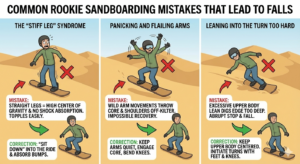
The “Stiff Leg” Syndrome
As speed increases, fear kicks in. The natural fear response is to stand up straight and tense the muscles. As soon as your legs straighten, your center of gravity shoots up, and you lose your shock absorbers. The next bump you hit will topple you. Correction: Constantly remind yourself to “sit down” into the ride.
Panicking and Flailing Arms
When balance becomes precarious, beginners often start windmilling their arms wildly in an attempt to counter-balance. This flailing actually throws your core and shoulders off-kilter, making recovery almost impossible. Correction: Keep your arms relatively quiet, using them only for minor balance adjustments, and focus on re-engaging your core and bending your knees.
Leaning into the Turn Too Hard
Unlike snowboarding where you lean your whole body into a carve, sandboarding turns are subtler, driven more by ankle flexion and knee movement. Leaning your upper body too far over your toe or heel edge will cause the edge of the board to dig too deeply into the sand, causing an abrupt stop and a fall. Correction: Keep your upper body relatively centered over the board and initiate turns with your feet and knees.
Beyond the Basics: Building Endurance for Longer Rides
Once you have mastered the basics of sandboarding for beginners and are no longer falling on every run, you will encounter a new challenge: fatigue. Sandboarding is physically demanding.
The act of riding requires constant leg and core engagement. The low, squatting stance burns the quadriceps and glutes intensely. Furthermore, the hardest part of sandboarding isn’t the ride down; it’s the hike back up. Walking up a steep, shifting sand dune is exhausting cardio.
To enjoy longer sessions without your legs turning to jelly (which leads to lazy form and more falls), consider working on your fitness off the dunes.
-
Squats and Lunges: Build leg strength to maintain that low stance for longer periods.
-
Core Work (Planks, Crunches): A strong core improves balance and stability.
-
Cardio: Improve your stamina for those grueling hikes back to the summit.

Conclusion
Sandboarding is a magical way to experience the desert, combining the serenity of the landscape with the rush of gravity-fed speed. While the learning curve involves dealing with friction and shifting terrain, it is far from insurmountable.
By approaching sandboarding for beginners with the right mindset and preparation, you can dramatically cut down on the learning time. Remember that the sand demands respect—you must wax your board religiously, protect your skin, and adopt the humble, low stance that keeps you stable.
Forget what you know about snow, keep your weight firmly over that back leg, keep your eyes on the prize ahead, and don’t be afraid to start small. Most importantly, learn to laugh when you tumble. Every fall is just a lesson in balance, bringing you one run closer to that perfect, endless glide down a golden mountain of sand. So wax up, strap in, lean back, and enjoy the ride.

